Everything You Need to Know About Solar Powered Drones in 2023
Drones are the unmanned air cars (UAVs) that are getting popular day by day, these can be autonomously used with ingrained software or controlled remotely.
UAVs were originally developed through the twentieth century for military objectives, now these are being used in forest fire monitoring, aerial photography, agriculture, patrolling along border lines and aerial surveillance etc
Up until 2013, drone or UAV innovation was mainly the domain of the defense market. Nevertheless, In the last few years, a substantial increase has actually been seen in research and development expenses for solar-powered air travel, particularly in drones, UAVs and other solar-powered aircraft.
In this post, I will be covering everything about the solar powered drones, including their working and also about some popular solar drones.
How Do Solar Powered Drones Work?
A drone could be flown without a battery as long as the sun is shining. Isn't it remarkable? Just add photovoltaic panels in a drone and it does not require a battery to fly.
The three main features of a UAV system are the:
- Airplane with other or common sensing unit functions.
- Ground control station (which may consist of an information processing centre).
- Operator (or software instructions).
In general, drones have four motors. The drone can hover, climb, descend, and turn by varying the power to these four motors.
Let's comprehend the physics of drones for each of the movements performed by drones.
Vertical Motion
Drone uses its rotors for propulsion and control. As the spinning blades press the air downwards, the air pushes up on the rotors.
This basic idea is utilized to control up and downward movement. Faster the rotation of the rotor, the higher will be the lift and vice-versa.
Turning (or turning)
Let's elaborate this with a diagram given listed below:
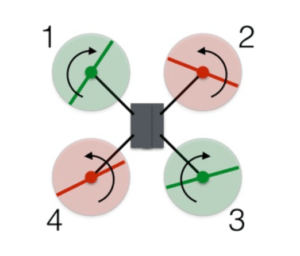
The red rotors turn counterclockwise and the green ones turn clockwise in this configuration.
The overall angular momentum of the two rotor sets is zero when they turn in opposite instructions.
And, the angular momentum depends upon the rotors' spinning speed.
When we reduce the spin of rotor 1 and 3 and increase the spin for rotors 2 and 4. In order for the drone body to rotate, the angular momentum of the rotors should equate to zero.
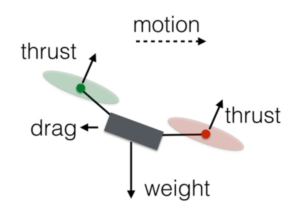
Forwards Sideways
The rotors need to generate forward embedded order to fly forward. The side view (with forces) of a drone is provided which is moving at a continuous speed.
Because there is a greater force in the drone's back, it will tilt forward.
Adding thrust to all rotors will produce a net thrust force that balances the weight and progresses.
In the case of solar powered drones, panels were too large for drones to be powered by them. With the thin, flexible, lightweight solar panels, the scenario has actually changed.
A versatile solar panel is made by slicing silicon wafers to a few micrometers thick. Most solar panels are up to 200 micrometers thick.
Solar energy drones bring lithium ion batteries. The solar batteries will charge lithium ion batteries for longer flight time.
Applications of Solar Powered Drones
These solar-powered UAVs have similar usage cases to basic drones. The drone transformation is changing the primary areas of activity, given that drones can manage complex tasks and decrease expenses.
Drones have the capability to gather real time data efficiently, to provide loads and have actually started the rapid-fire elaboration of numerous artificial, valuable, and recreational operations.
Some basic applications are listed below:.
01. For Safety Inspection.
Solar energy drones can be used for security evaluations in a variety of ways. They can be used to check dangerous locations that are tough to gain access to with conventional techniques.
These gadgets can also be utilized to examine pipelines and other facilities for any prospective damage or leakage.
In addition, drones are super beneficial in monitoring dangerous websites for any potential ecological hazards, such as chemical spills or radiation and even harmed buildings or particles.
02. For Medical Purposes.
Drones are capable of providing microbiological and laboratory samples, pharmaceuticals, vaccines, emergency medical devices, and patient transports.
They can be used to transport medical materials and personnel to otherwise difficult-to-reach places, to keep track of and survey remote locations for health hazards, or to offer telecoms services in areas with limited access to innovation.
03. For Surveillance.
Most UAVs are (or can be) equipped with cam innovations that can tape-record and transmit image images to the ground control station.
These innovations have come cheaper and even more sophisticated and allow image detainees at lower ranges with lesser resolution.
04. Crop Tracking.
In order to accomplish the best yields, farmers use the field information collected by drones to prepare their planting and treatments.
In a market with generally slim revenue margins, precision farming systems can increase yields by as much as 5%, which is a substantial boost.
05. In Militaries.
Military use of drones has become the primary usage worldwide. It is mainly utilized for target decoys, for research advancement and guidance.
Solar energy drones can be used in armed forces for a range of purposes. They can be utilized for reconnaissance, monitoring, and reconnaissance-strike objectives. In addition, these can be utilized for intelligence event, border patrol, and search and rescue operations.
These drones offer the benefit of having the ability to remain air-borne for longer periods of time than standard powered drones, providing a more affordable and reliable methods of gathering data.
06. Spray Application.
Drone sprayers are used to browse extremely hard to reach areas, such as high tea fields at high elevations and perform targeted sprays.
07. Planting and Seeding.
Automated drone seeders are primarily being used in forestry industries where there are hard to reach or threatening areas.
Given that drones can be remotely controlled and flown at numerous ranges and heights, they are best for taking on some of the most difficult tasks.
A drone has actually even made its way into our houses as a source of home entertainment for enthusiasts and a vital tool for professional photographers.
Drone has already been changed in numerous fields and existing drone innovations are likewise enhancing Artificial Intelligence to make drone technology more useful and reliable methods.
Problems and Unpredictabilities
Normally solar energy drones need long flight time and reputable power supply. Nevertheless, existing UAV designs using standard battery or fuel cells typically struggle to fulfill such requirements.
Mounting photovoltaic panels onto the quadcopter is hard to accomplish considering that photovoltaic panels are susceptible and vulnerable, it's simple to bring damage to the solar panels.
Currently, the best solar batteries readily available in the market have an efficiency of roughly 20%, which is just able to extend the flight time.
Market barriers for civil and commercial applications include:
- Insufficient or immature air area guidelines that impact UAV systems.
- Liability for civil operations.
- No safe non-military frequencies.
- Unfavorable customer perception.
- Absence of operator training/safety requirements.
- Restricted payload capacity and area constraints.
Some Most Advanced Drones Worldwide
Drones are ending up being progressively popular, and it is no surprise-- they are incredibly versatile machines! From catching stunning aerial video to offering important data for organizations, drones can do all of it.
In this section, we'll be checking out a few of the most advanced drones worldwide today. We'll look at their features, specs, and abilities that make them differ from the rest.
1. Breeze.
This is a solar powered drone built by Plane which is currently in the testing stage by the United States Army. It flies in a stratosphere that is above the weather.
It can be hand-launched from a runway and regardless of having a wingspan of 82 feet, it weighs around 165 pounds. On June 15, 2022, the Army launched a Breeze aircraft that stayed in the air as of July 29, setting a new world record for long-endurance flight.
2. SolarXOne.
A French business XSun presents this totally solar energy UAV, programmable to be 100% autonomous throughout all flight phases.
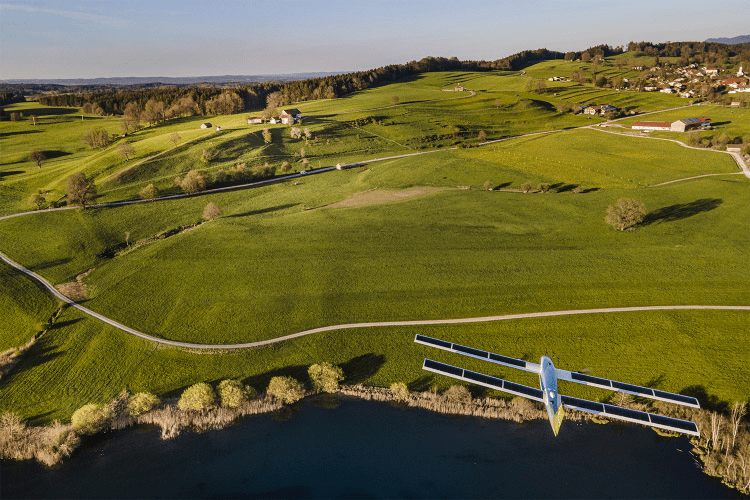
With a wingspan of 4.5 meters and a weight of 25 kg, it can bring as much as 5 kg of payload, which can consist of gyroscopes, thermal imaging video cameras, LIDAR, and advanced communications equipment. It has an everyday flight endurance of 600 km and has a series of 12 hours day and night.
3. Qimingxing-50.
This is China's very first solar powered drone or satellite with a high altitude long endurance with a broad period of 50m. It is the first large-sized UAV powered just by solar energy is capable of high elevation aerial reconnaissance, evaluating forest fire and can also be used for communications. This drone can be utilized in the field of renewable resource, brand-new products and aerial engineering.
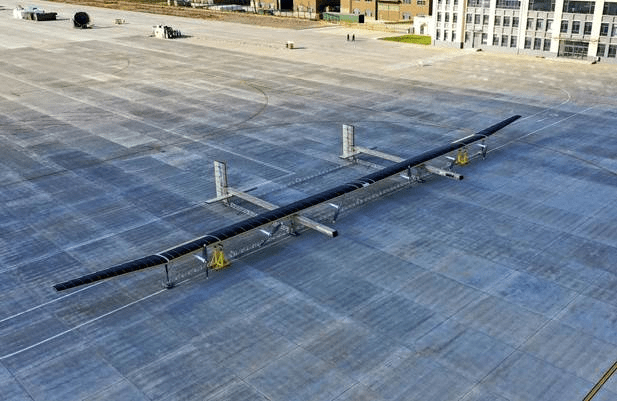
Business that produce drones are developing ingenious services to provide advanced surveillance and security capabilities for tracking and protecting assets.
Future of Solar Powered Drones
It has been seen that small personal companies, and large tech- and aviation companies delve into the drone industry. The drone market was approximated by ABI research to climb to $8.4 billion by 2019. It's not just the offers of the take on, it's significantly the operations and services where utmost growth is prepared for.
Among the most instigative advancements in UAV technology has been using solar power. The global solar- powered UAV demand is prepared for to be valued at $378.2 million in 2025, and is forecasted to reach $881.7 million by 2035, growing at a CAGR of 8.6 from 2026 to 2035.
The evolution of innovations such as artificial intelligence, 3D imaging, big information analytics, and others has promoted the development in the adoption of advanced innovations in drones for achieving time-sensitive missions. The technological improvements in drones propels the use of contemporary drones in many industries.


Comments
Post a Comment